

If you already run a business, an online course can look like an easy extra income stream. Then you start, and find that creating an online course is a job in itself for at least a month or two. Even after launch, you have to run the site and look after your learners.
Most people don’t have that much spare time, so they build the course on nights and weekends. That only lasts so long before you burn out, and a tired course creator rarely builds a good learning experience.
So this guide does two jobs. It takes you through how to create an online course, step by step, from the idea to launch. And at each step it shows you how to save time, so you get there without wearing yourself out.
The eight steps:
- Choose a topic people will pay for
- Know who the course is for
- Test demand before you build
- Plan the work, honestly
- Design the learning
- Choose a platform and set it up
- Price the course
- Launch, then keep going
1. Choose a topic people will pay for
The best topic sits where your expertise meets a problem people already want solved. It’s tempting to start with what you’d enjoy teaching. Start instead with the questions people keep asking you, the problems your clients pay you to fix and the mistakes you see over and over.
Narrow it down. “Marketing” is a library. “Getting your first ten clients as a freelance bookkeeper” is a course.
There’s more on this, including how to check the competition, in how to choose the perfect online course topic.
2. Know who the course is for
Every decision that follows gets easier once you know your target audience well enough to picture one real learner: what they do all day, what they’ve already tried, how much time they have and what success looks like to them. A course for busy managers who’ll watch on a phone between meetings looks very different from one for hobbyists with a free Saturday.
Write it down as a short learner persona. Our guide who is my ideal learner? shows you how.
3. Test demand before you build

Start with a minimum viable course
MVP stands for minimum viable product, a term popularised by Eric Ries in The Lean Startup. The idea is to test your idea with real customers as quickly and cheaply as possible, by building the first version that someone would actually pay for.
Developing and marketing a course can be expensive. You might pay for professional video, animation and copywriting, hire e-learning developers and spend thousands on advertising. Until you start talking to your audience, your ideas are hunches about what might work. An MVP lets you test them, win your first loyal customers and learn what to improve.
Say you’re an expert in data protection. You want to offer a course on data security for charities, because you think the sector has risks nobody is addressing. You could write an hour-long course, spend thousands on production and start marketing it, only to find that charities have little money for training like this and plenty of free options.
Or you could run a free online workshop on the risks charities face. It’s cheaper and faster, and it builds your reputation in that market. You might find there’s room for a course, at a much lower price than you planned. Or you might spot a better opportunity and change direction. Either way, you’re making better decisions with better information.
Or coach first
If you have real expertise, one of the best shortcuts is to coach before you create content. Writing content is a lot of work, and until you’ve worked with your audience you won’t know if you’re writing the right thing. Coaching lets you use the knowledge in your head, and get paid while you explore the themes of the course.

Over time you’ll see which problems come up again and again, and which solutions help most. Writing the course gets much easier, your videos come out better because you’ve been rehearsing in every session, and you’ll have testimonials that fit the programme. It only works if you can draw on your experience on the spot, so it isn’t for everyone.
For quick, intermediate and advanced ways to test an idea, plus a simple go, adjust or stop decision, read how to validate your online course idea before you build it.
4. Plan the work, honestly
Optimism bias affects all of us. It’s when we expect better-than-average outcomes: “that’ll never happen to me”. It’s very common in projects. We overestimate the time we have, and underestimate how long tasks take and what they cost. Most first-time course creators fall into it.
So before you plan, be honest with yourself, and talk it over with someone who knows you well:
- Are your goals realistic for the time you have?
- How much does it matter if you hit those dates?
- What will you give up to make the course happen? Evenings out, hobbies, family time or client work? Is it worth it?
- What else could slow you down, and what can you do about it now?
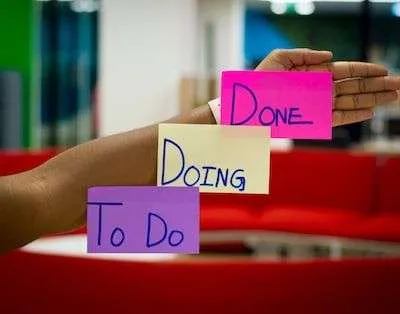
Then make a plan. A spreadsheet is fine. If you like something more visual, Trello has a free plan.
- Break the course down into deliverables: the modules, videos, worksheets and quizzes.
- Break each deliverable into tasks, and the bigger tasks into smaller ones.
- Put a time against each task, then schedule and order them by what matters most.
- Tick them off as you go. It’s satisfying, and it builds momentum.
Planning takes time, but once it’s done you always know what to do next. When you sit down to work on the course, you don’t waste the first half hour deciding where to start.
5. Design the learning
This is the step most guides skip, and it’s the one that decides whether people finish your course and get results.
Start with what learners should be able to do at the end, not with what you want to tell them. Then plan the practice that gets them there: scenarios, exercises, quizzes that ask them to make a decision, and feedback when they get it wrong. Videos and reading support that practice. They don’t replace it.
Give the course a simple structure: a few modules, each made of short lessons, and a quiz or practice task at the end of each module. Keep each lesson focused on one idea. Think about where your learner will be, too. If they’ll study on a phone between meetings, a 40-minute video won’t get watched.
We design every course with our MICAP framework: Motivation, Ideas, Context, Action, Performance. You can see how we use it, and where AI saves us time, in AI course design for LearnWorlds.
6. Choose a platform and set it up

You can sell through a marketplace like Udemy, or run your own academy on a course platform. A marketplace brings an audience but sets the price and keeps the customer relationship. Your own academy means you own the brand, the price and the learner list, and you bring the traffic.
When you compare platforms, look at the learning experience as well as the sales tools: quizzes, interactive video, certificates, mobile apps, reporting and how easy it is to sell to businesses as well as individuals. Most platforms offer a free trial, so build one short lesson before you commit.
Two guides go into more detail: how to choose an online course platform for beginners, and how to choose the best course platform for serious course creators.
We build on LearnWorlds. If that’s your choice, the free Academy Readiness Check takes about three minutes. It gives you a score, your biggest gaps and a 30-day plan for setting your school up.
7. Price the course
Price follows value, not length. A short course that solves an expensive problem can sell for more than a long one that’s nice to know. Look at what your learner would otherwise spend, in money or time, to fix the problem, and at what similar courses cost.
You don’t have to start with a single price. Many creators begin with a lower founding price for the first group and raise it as the testimonials come in.
The complete guide to pricing online courses covers the five main pricing models and how to raise prices without losing sales.
8. Launch, then keep going

Launch to the people you met in step 3 first: your workshop attendees, coaching clients and the people who said yes to the idea. Ask them for feedback and testimonials, and fix what trips them up before you spend money on advertising.
Then keep going. If nobody else knows your plans, they’re easy to let slide. An accountability partner gives you somewhere to talk through the hard weeks and celebrate the good ones:
- A coach. A good one will help you set goals and challenge you on how you’ll reach them.
- Your network. Tell people what you’re building and when. Saying it out loud, even to a stranger, creates a commitment you won’t want to break. Just keep the dates realistic.
- A colleague, friend or relative. Set up regular check-ins. It works well both ways if they have a project of their own, and it doesn’t need to be another course creator.
Before you scale up, it’s worth checking that the numbers work. Business models for LearnWorlds clients covers what to work out before you build a bigger site.
Frequently asked questions
How long does it take to create an online course?
For most people creating their first course alongside a business, plan on at least a month or two of real work, and longer if you’re producing professional video. Coaching first, or launching a minimum viable course, gets you to paying learners much sooner, because you build the full course content with their feedback.
How do you structure an online course?
Work back from what learners should be able to do at the end. Group that into a few modules, split each module into short lessons of one idea each, and end every module with practice: a quiz, a scenario or a task they complete. A clear course structure also helps learners see their progress, which keeps them going.
Can you create an online course for free?
You can test one for free. A free workshop, a few coaching sessions or a platform’s free trial will tell you whether people want the course before you spend anything. Selling from your own academy, with your own branding and payments, usually needs a paid plan.
Can AI create an online course?
AI can draft a lot of it: outlines, video scripts and quiz questions. LearnWorlds has its own AI tools, and its connector for Claude can build a draft course with sections, lessons and a quiz in about a minute. It can’t tell you whether anyone wants the course, or whether the learning works. That still needs you, or a learning designer. Here’s how to connect LearnWorlds to Claude.
Do you need technical skills to create an online course?
No. A course platform handles the hosting, payments and delivery of your online learning. If you can use a website page builder, you can set up a course. The harder skills are the ones in this guide: choosing the right topic and designing learning experiences that people finish.
Summary
- Choose a topic where your expertise meets a problem people pay to fix.
- Picture one real learner and design for them.
- Test demand with a minimum viable course or by coaching first.
- Be honest about your time, then plan the work.
- Design for what learners will be able to do, with plenty of practice.
- Pick a platform that fits your business, and try it before you commit.
- Price on value, not length.
- Launch to the people who helped you test it, and find someone to keep you going.
If you plan to build on LearnWorlds, start with the free Academy Readiness Check. If you’d like help with the design or the build, see our services.